
 Serhii Rudiuk
Military and Political Expert
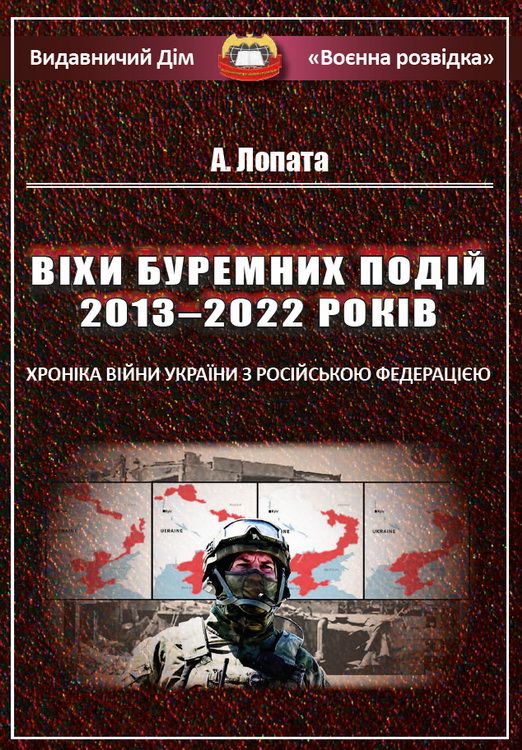
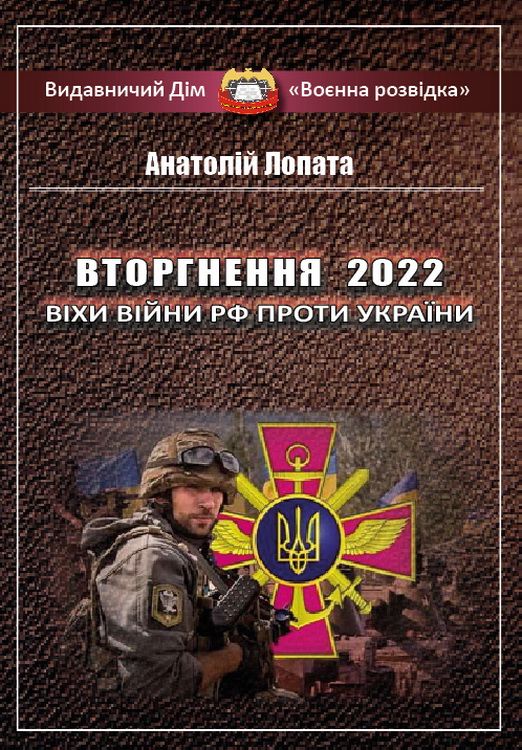
Each war already in its course becomes subject to study and analysis by professionals in military science, and, especially, after its end. The current Russian-Ukrainian war will be no exception. However, for this it is already necessary to collect relevant materials and systematize them. And it’s good that this is already being done. Thus, in late 2022 – early 2023, the Kyiv Publishing House “Military Intelligence” published two works by the former Chief of the General Staff, First Deputy Minister of Defense of Ukraine Colonel General Anatolii Lopata: “Milestones of the Turbulent Events of 2013–2022. Chronicle of the War Between Ukraine and the Russian Federation” and “The 2022 Invasion. Milestones of Russia’s War Against Ukraine”. Both works are documentary studies of the events of 2013–2022 in Ukraine. They are the author’s attempts to systematize the most important events of that period in Ukraine and abroad. He, as a professional military, seeks to help the reader comprehend them. At the same time, the author stresses that he does not aim to analyze and evaluate combat operations on the front lines. In his opinion, this is a responsibility of military analysts after the war.
 |
 |
Despite modesty in his own self-esteem, because people with such a brilliant education and rich professional experience cannot help being analysts, Lopata, although in general terms, still gave an analysis of the historical period of time that preceded the Russian-Ukrainian war of 2013–2023, in particular in the context of Ukrainian state-building and defense construction. He absolutely correctly formulated the thesis, which was (I will not go into detail — by whom) laid down in the ideology of building an independent Ukraine at the dawn of its creation: “There can no longer be a war between the peoples of Russia and Ukraine!” The following remark is also true: “This point of view had been supported by the leadership of our State for many years after the collapse of the Soviet Union”, that is, “…native leaders, who professed the gained independence only in words, because they neglected the basis of this independence — the defense capability of the State”. And, as a result: “Ukraine’s defense capability has been consistently destroyed”.
|
…There are three components of the statehood of every nation: land, people and the armed force… |
Apparently, after all, that leadership was not really native to the Ukrainian people. Because then they would not have neglected the historical experience of Ukrainian state-building, but would have taken into account the words of the Minister of Military Affairs and Chief of the General Staff of the Army of the Ukrainian People’s Republic, Khorunzhii General Vsevolod Petriv (1883–1948), said to the Ukrainian community of Czechoslovakia in 1936. He said: “There are three components of the statehood of every nation: territory — land, people who live on this piece of land limited by borders, and the armed force that defends this state territory.
So, territory + people + army = state.
Of these three components, the army is only strong when it is built on the foundation of the land (territory) and the people who live on this land, and therefore the person who was once called to the building of the army does not dare not know the foundations on which this army is built”.
Unfortunately, the then “native leadership” had different views on the Ukrainian ethnic and state territory, on Ukrainians themselves and on the Ukrainian army. I can confirm this with my own observations, in particular in the case of Crimea, Sevastopol and the Navy of the Armed Forces of Ukraine.
February 2–3, 1991 in Kyiv in the assembly hall of the Union of Writers of Ukraine was held the conference “External and Internal Security of Ukraine. The Concept of the Ukrainian Army and the Search for Ways to Create It”. Among its participants were Members of Parliament of Ukraine, officers, public activists. As Chairman of the Lviv Public Committee for the Revival of the Ukrainian National Army, I presented to the audience the Concept of the Armed Forces of Ukraine. The concept touched upon various aspects of the future defense construction, but for some reason Doctor of Historical Sciences Anatolii Rusnachenko singled out only the following: “The speaker argued that the army should be created based on the feelings of all citizens of Ukraine, soldiers and officers, creating a structure parallel to the official ones in order to have something to rely on in case of disaster. However, this idea did not find wide support at the conference”. A few months later, the trouble did happen — an armed putsch of the so-called State Emergency Committee, during which the same Lviv Public Committee for the Revival of the Ukrainian National Army established, so to speak, “…a structure parallel to the official ones” — the National Guard of Ukraine. Circumstances forced former conference participants to agree to this. And support. That’s what sometimes happens.
But why do I mention this? In 1993, I read the article by the First Deputy Minister of Defense Colonel General Anatolii Lopata “Reforming the Army Is More Difficult than Building It from Scrap” (newspaper People’s Army, December 15, 1993). It read: “The Army should have been built from scrap”. I took this as a confirmation of the correctness of the Committee’s position on the need to create a new army of new people on a new, national basis. I also read a similar opinion in an interview with the Head of the Department of Strategy of the Academy of the Armed Forces of Ukraine, Lieutenant General Oleksii Lavreniuk, to the newspaper For Free Ukraine (Lviv), reprinted by the magazine Visti Kombatanta, Issue 3, 1996 (London).
|
…The government and the army are one whole, the army will be exactly as it is seen by the government… |
To the question of journalist Mariia Bazeliuk: “What kind of army does Ukraine need today?” Lavreniuk replied: “The Armed Forces of Ukraine that we have today are not a national, people’s army, which is needed by our state. I strongly insist that the army be ethnic, that mainly Ukrainians study in military universities, command posts be occupied by Ukrainians and the government be Ukrainian. Because the government and the army are one whole, the army will be exactly as it is seen by the government”.
In other words, renaming the headquarters of the Kyiv Military District to the Ministry of Defense of Ukraine alone will not make it Ukrainian. Simple renaming are not a “reform”, but rather an imitation with far-reaching disastrous consequences. And this also applies to other bodies of state power, in particular the top one: legislative, executive and judicial.
The above-mentioned conference was addressed by the then Deputy Chairman of the Presidium of the Verkhovna Rada of Ukraine Volodymyr Hryniov. Perhaps it will not be an exaggeration to consider him one of the conductors of the ideology of the “new Russians” in Ukraine. In the rank of adviser to the President of Ukraine Leonid Kuchma on regional policy, Hryniov said that Sevastopol in the future would be “demilitarized” and turned into a commercial port, “an economic oasis, a la Hong Kong city”.
Such words voiced by one of the leaders of the state sounded strange to say the least. Senior Adjutant of the Minister of the Navy of the Ukrainian State, Lieutenant Captain Sviatoslav Shramchenko (1893–1958) in his article “Ukrainian Naval Policy in Crimea in 1917–1918” emphasized the “categorical necessity” of the Crimean peninsula’s belonging to Ukraine. In his opinion, “…Sevastopol — the main Black Sea military port — has an exceptionally advantageous tactical and strategic position, on the one hand — in relation to all possible directions of active combat activity of its fleet against any enemy fleet, and on the other hand — as the best place from which it is possible to defend its communication lines and its coast in the best way”.
But other opinions prevailed in the top state leadership of independent Ukraine. In his article “The Battle of Crimea. Federalization in the Absence of the Rule of Law Causes Degradation of Regions”’ (The Week, September 10, 2012), Ihor Losev complains about the “limited thinking” of the then chief of Ukrainian diplomacy Anatolii Zlenko: “While the Russian side saw the Black Sea Fleet as an extremely important military-political tool to protect its state interests, Zlenko and his commission did not attach to the Navy such importance for the state. Like, we don’t need a fleet, we just need some small flotilla”.
No wonder A. Lopata with his characteristic restraint points out: “Special circumstances were in the formation of the Ukrainian Navy as a former part of the Black Sea Fleet of the USSR”. Some of these “special circumstances” are known to me. I remember, while working in the Standing Commission of the Verkhovna Rada of Ukraine on Defense and State Security, once I accidentally witnessed a conversation between a member of the working group on the preparation of a package of draft military legislation Colonel V. Lazorkin (head of the air defense military course of the Joint Military Department of the Lviv Polytechnic Institute) and another, unfamiliar officer. It was about what should be the Navy of independent Ukraine. Colonel Lazorkin persuaded his interlocutor that Ukraine did not need a navy. Saying that a small flotilla would be enough to protect the coast. I didn’t like it. But I did not interfere in the conversation. Instead, I wrote and submitted for consideration to the Chairman of the Standing Commission V. Durdynets a draft government telegram to the command of the Black Sea Fleet of the USSR with a request to send Captain Lieutenant I. Teniukh to Kyiv to the working group for the preparation of a package of draft military legislation. I attached a home address and officer’s phone number to the project. “Better a navy captain-lieutenant of the Black Sea Fleet works on the Navy than a Colonel of the Air Defense”, I thought.
After his arrival in Kyiv, Teniukh proposed to include several senior naval officers in the working group of the Commission. Thus, the Organizational Group of the Navy of Ukraine was established. Its members were doing their best to create a full-fledged Ukrainian military fleet. But politicians were doing the opposite.
|
…He who rules Crimea, rules Ukraine… |
Interestingly, the political decision on the joint basing in Sevastopol of two Navies — Russian and Ukrainian — is diametrically differently assessed by the military of both countries. Thus, President of the Academy of Geopolitical Problems, former Chief of the Main Directorate for International Military Cooperation of the Ministry of Defense of Russia (1996–2001), Colonel General L. Ivashov positively evaluates this decision. And we understand why: this decision laid the foundation for the annexation of the Crimean Autonomy of Ukraine in 2014 by the Russian Federation. Although Ivashov sometimes criticizes certain actions of V. Putin’s regime, he approves of this annexation. He even tries to substantiate it with international law, slyly at that. After all, the right of nations to self-determination and the formation of their own national states through a referendum, which Ivashov cites, concerns indigenous peoples, not migrants. And the Russians of Crimea are only migrants from Russia and have no right to determine the territorial affiliation of their territory of residence. This right belongs exclusively to the Ukrainian people.
The Ukrainian view on the decision of politicians of that time is now outlined by the former Chief of the General Staff — First Deputy Minister of Defense Colonel General A. Lopata: “The deployment of two fleets in Sevastopol and the morally unfavorable environment in the formation of a patriot of Ukraine against the background and in comparison with the activities of sailors and units of the Black Sea Fleet, have done their dark deed”. This should be understood by those who continue to believe in all sorts of “joint” military and infrastructure projects. The experience of “joint” basing of fleets of different countries in the ports of the Ukrainian Crimea teaches: for the future — no “joint” basing of navies! Because: “He who rules Crimea, rules Ukraine, even independent Ukraine. This was true when the khan was sitting in Bakhchysaray, this was true when in 1855 a Frenchman was sitting in Sevastopol, this was true when in 1918 a German was sitting there and this is true when the moskal is sitting there again” (V. Inhulets. For the Ukrainian Sea. — Prague, 1941). Therefore, there should be only one owner in Ukrainian territorial waters — the Navy of the Armed Forces of Ukraine! In the meantime, in the words of A. Lopata: “The surrender of Crimea by the Armed Forces of Ukraine will go down in their history as a black page”.
|
…One of the reasons for the Crimean catastrophe of 2014 is miscalculations in the organization of naval units on a territorial basis… |
Lopata’s another important for readers remark in the context of considering the reasons for the Crimean catastrophe of 2014 is “miscalculations in the organization of naval units on a territorial basis”. This miscalculation should be taken into account by apologists for the creation of the Territorial Defense Forces of the Armed Forces of Ukraine. They should be reminded that from the former Ukrainian SSR we inherited three military districts: Kyiv, Odesa and Prykarpattia. Experts know that one of the many tasks of the military district is territorial defense. The command of the military district has the appropriate forces and means for this. And it does not require any other force. But it was created. After the liquidation of military districts. Although some military experts warned the Ukrainian society against taking actions that would turn the army into “princely squads who will live at the expense of the regions”. But they were not heard. Because someone wanted to privatize the Armed Forces of Ukraine and replace them with private military companies that would earn money for them in hot spots of the world, someone from the newly minted “feudal lords-latifundists” wanted to have a “funny army” like the “court militia”’ of the 18th century’s Polish magnates of Right-Bank Ukraine, which would protect their estates from the possible envy of the surrounding poor, and someone wanted the spoilt child to perform military service near his mother’s skirt. Or not to serve in the army at all, because those would be “wasted years”. While the world centers of power, as well as “neighbors” wanted to undermine Ukraine’s defense capability by minimizing or even completely eliminating its mobilization reserves. After that, the destruction of Ukraine’s independence and its transformation from a subject of international law into an object of merciless exploitation would be a matter of time.
Unfortunately, the top military-political leadership of Ukraine, instead of preserving and strengthening the inherited effective defense organization of the state, imitated the “reform”, which hid primitive bribery of voters by reducing the conscription and the term of military service of their sons, arms trade from disbanded military districts in foreign markets, and finally, criminal deals with military infrastructure, as a result, in the words of A. Lopata “…The Armed Forces of Ukraine have become incapable of fulfilling their constitutional duties: defense of Ukraine, protection of its sovereignty, territorial integrity and inviolability”.
As you know, the territory of Ukraine is 603.7 thousand square kilometers. The total length of the state borders of Ukraine is estimated at almost 6500 km, of which the maritime borders (along the coastline, excluding the length of the shores of bays and the length of the coastlines of the Black Sea estuaries) account for 1050 km. So can a “small, mobile, professional” army protect all this? Can the so-called Mosquito fleet protect it? Questions to every citizen of Ukraine. After all, according to Article 17 of the Constitution of Ukraine: “Protection of sovereignty and territorial integrity of Ukraine, ensuring its economic and information security are the most important functions of the state, the cause of all Ukrainian people”.
|
…Perhaps the citizens of Ukraine, united by the enemy invasion, will draw their conclusions from the miscalculations of the past years in defending the State?.. |
Therefore, A. Lopata is absolutely right when he states: “In Ukraine, it is necessary to preserve the possibility of conscription of young people for military service. Every citizen must be able and ready to defend himself, his family, his home, his country”.
Today, our people are bleeding on the fields of battles with the Russian occupiers, paying with their health and lives for what they themselves and their top political and military-political leadership have done in the past. This is a tragedy. But also another historical lesson. And Colonel General A. Lopata asks: “Perhaps the citizens of Ukraine, united by the enemy invasion, will draw their conclusions from the miscalculations of the past years in defending the State?” I would like this to happen. “The younger generation will answer these questions based on an in-depth analysis of the activities of “predecessors”. It will determine the role and place of every official in political and economic miscalculations, theft of state property, which led to the loss of the state’s defense capability”. And he emphasizes: “Development of the economy and on its basis of the defense industry, military science and modern weapons, providing them to the Armed Forces is the key to our success and victory, and social protection of the military and members of their families should be a priority of the authorities.
Ukraine will win!”


